



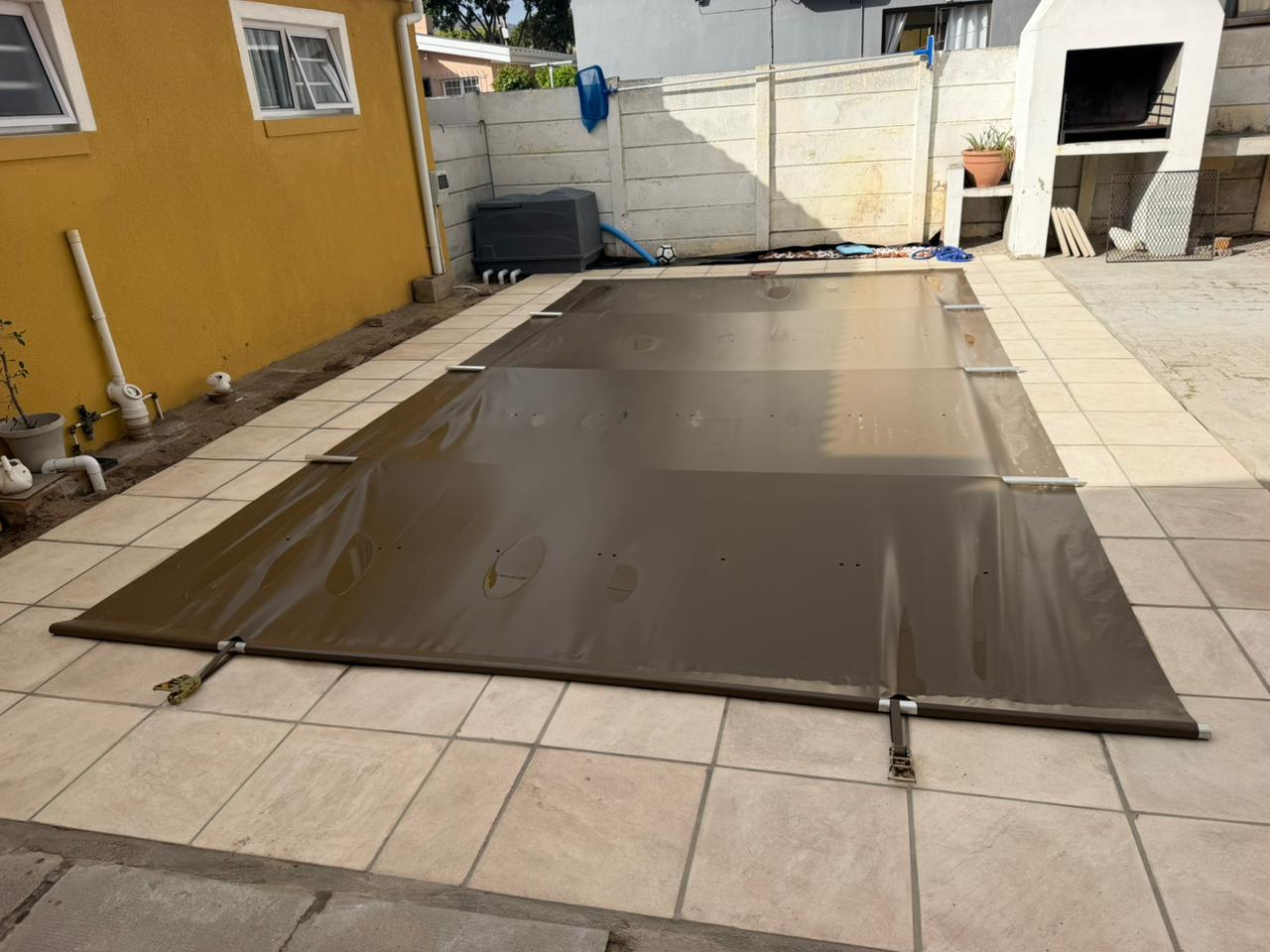
If you’ve ever tried to keep a pool clean through a Cape Town summer, you already know the two biggest enemies: evaporation and wind-blown debris. A pool cover helps with both — and depending on the cover you choose, it can also retain heat, reduce chemical use, and add a serious safety barrier for kids and pets.
But when people ask “How much does a pool cover cost in Cape Town?”, the honest answer is: it depends on your pool’s size, shape, and the type of cover you want. So let’s break it down in a practical way, with real-world ranges you can use for budgeting (and a few tips to avoid paying for the wrong thing).
Quick Cape Town pool cover price guide
Here are realistic budget ranges many Cape Town homeowners use as a starting point:
- Bubble / solar blanket: roughly R3,000 – R5,000 for many standard pools
- PVC safety cover (manual safety cover): roughly R6,000 – R15,000
- Automatic slatted cover (key/remote): roughly R30,000 – R45,000+
- High-end automatic systems & pool-deck style covers: often R120,000 – R150,000+
You’ll notice the jump is big once you move from “manual covers” to “automatic covers”. That’s normal — you’re paying for mechanics, housing, and installation complexity.
Need a Custom Quote in Cape Town?
Fill the form below and one of our experienced pool technicians will be in touch as soon as possible.
Pool cover prices by type
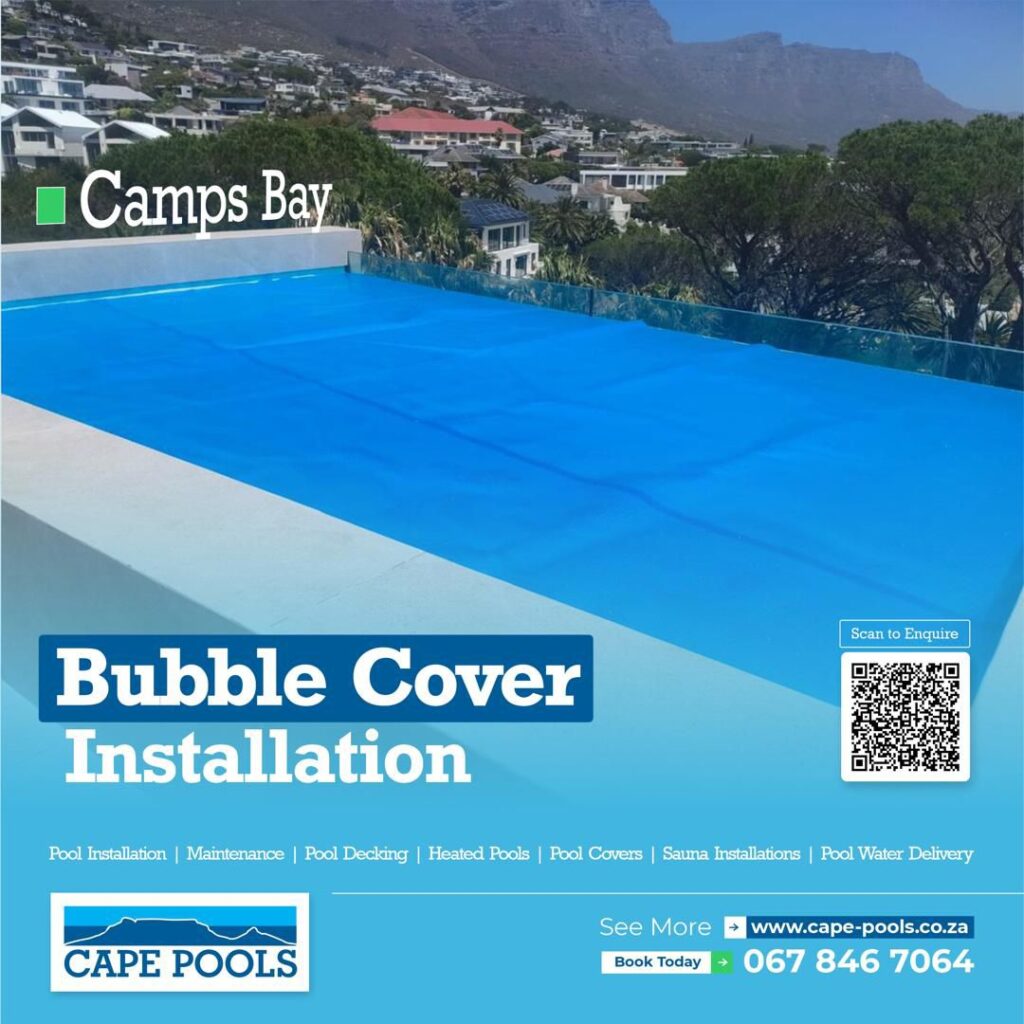
1) Bubble cover / solar blanket pricing (best budget option)
A bubble cover (often called a solar blanket) is usually the cheapest way to get water-saving + some heat retention.
A useful benchmark: some suppliers price solar covers per square metre — for example, R98/m² (incl. VAT) is shown by one South African supplier as a current per-m² rate, before delivery and other add-ons.
In plain English: the bigger your pool surface area, the more it costs — and extras like edging, cut-to-shape, straps, and rollers push the price up.
Don’t forget the roller/reel: Many owners add a roll-up station because Cape Town wind can make daily handling annoying. Roll-up stations are often priced separately (example pricing shown: R3,950 – R5,250).
Best for: homeowners who want an affordable way to save water and warm the pool a bit, and don’t need a true safety barrier.
2) Safety net pricing (good safety-to-cost balance)
Safety nets are popular because they’re generally lighter than solid covers and still provide meaningful safety when properly installed.
Some safety-cover providers state that safety nets start from around R8,000 (size and shape depending).
Price usually increases with:
-
larger pools,
-
freeform/curvy shapes,
-
tricky paving/decking edges (anchors),
-
and higher-spec hardware.
Best for: families wanting a safety-first option without jumping straight to solid covers or automation.
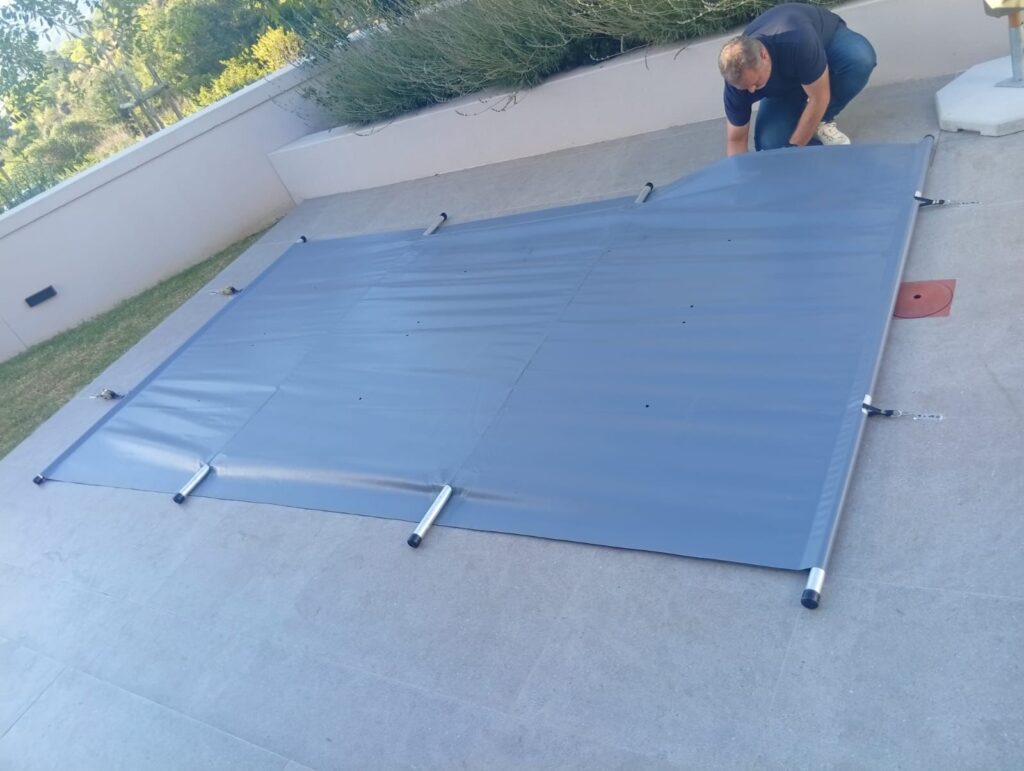
3) Solid PVC safety cover pricing (strong safety + cleaner pool)
A solid PVC safety cover is the “heavy-duty” manual option — a more complete physical barrier and excellent for keeping debris out (very helpful in windy areas).
Retail examples can help you sanity-check quotes: one listed example shows a 10m x 4m solid safety cover at R17,599.
That doesn’t mean your pool will cost exactly that — but it gives you a real Cape Town/South Africa market anchor for a large rectangular pool size.
Best for: homeowners who want maximum manual safety, better debris control than nets, and a more “sealed” pool.
4) Automatic slatted cover pricing (convenience + premium feel)
Automatic slatted covers are where convenience kicks in: turn a key / use a remote, and the cover rolls on/off neatly.
A practical local budgeting range often used for automatic slatted covers is R30,000 and up, and it can exceed R45,000 depending on size and spec.
Best for: people who actually want to use the cover daily — because if it’s easy, it gets used.
5) High-end automatic systems & pool-deck covers (luxury tier)
There’s a premium category too: covers integrated into decking, or higher-end automatic vinyl/slatted systems. Some providers advertise starting points like R120,000+ (automatic vinyl) and R150,000+ (slatted pool-deck systems).
Best for: high-end homes, design-focused builds, or clients who want the cover to be a feature — not just a utility.
Need a Custom Quote in Cape Town?
Fill the form below and one of our experienced pool technicians will be in touch as soon as possible.
What affects pool cover pricing in Cape Town?
Even with the same “type” of cover, two quotes can differ a lot. The usual reasons:
Pool size & shape
Rectangles are simpler and cheaper than kidney/freeform pools because cutting, edging, and tensioning become more complex.
Wind exposure (a Cape Town classic)
If your pool area gets hammered by wind, you may need better anchoring, stronger materials, and a setup that’s easier to open/close quickly (so you actually use it).
Access & installation complexity
Tight access, delicate paving, raised coping, or tricky deck finishes can make installation slower and more expensive.
Hardware quality
Anchors, straps, battens/poles, and ratchets matter. You don’t want “cheap” hardware failing in year two.
Extras that add up
-
Roll-up station / reel systemÂ
-
Custom edging & cut-outs for steps
-
Locking/tamper-resistant features
-
Automation upgrades
Example budgets for a common Cape Town pool size
Let’s say you have a typical 8m x 4m pool (surface area ±32m²). Very rough budgeting:
-
Solar/bubble cover: often lands in the “few thousand rand” bracket (commonly R3k–R5k for many pools), plus optional roller.
-
Safety net: commonly starts around R8k+, scaling with size/shape.
-
PVC safety cover: often falls into R6k–R15k, depending on size/spec.
-
Automatic slatted: commonly R30k–R45k+.
This is exactly why it helps to decide your priority first: budget, safety, heat, or convenience — because each pushes you toward a different product.
Need a Custom Quote in Cape Town?
Fill the form below and one of our experienced pool technicians will be in touch as soon as possible.
How to choose the right cover (without wasting money)
If your main goal is saving water and reducing heating loss, a solar/bubble cover is usually the best value.
If your main goal is safety, decide between:
-
Net (great safety-to-price balance, lighter daily handling), or
-
Solid PVC safety cover (more sealed, stronger “barrier feel”, better debris block).
If your main goal is actually using the cover every day, automation often wins — because the “best” cover is the one that doesn’t become a hassle after two weeks.
Need a Custom Quote in Cape Town?
Fill the form below and one of our experienced pool technicians will be in touch as soon as possible.
FAQs
How much do pool covers cost in Cape Town?
A realistic budgeting spread is: R3k–R5k for bubble covers, R6k–R15k for manual PVC safety covers, and R30k–R45k+ for automatic slatted covers — with luxury systems reaching R120k–R150k+.
What’s the cheapest pool cover that still saves water?
A solar/bubble cover is usually the cheapest water-saving option, and some suppliers price them per m² (e.g., R98/m² shown as a current benchmark by one SA supplier).Â
Do I need a roller for a bubble cover?
Not required — but in Cape Town’s wind, a roller often makes the difference between “we use it daily” and “it lives in the garage”. Some rollers are priced separately (example range R3,950–R5,250).
Is a safety net enough for child/pet safety?
A properly installed safety net can be a strong safety layer, but always treat it as part of a safety system (supervision, barriers, etc.). For pricing, some providers mention starting points around R8,000.
Need a Custom Quote in Cape Town?
Fill the form below and one of our experienced pool technicians will be in touch as soon as possible.


Comments are closed