



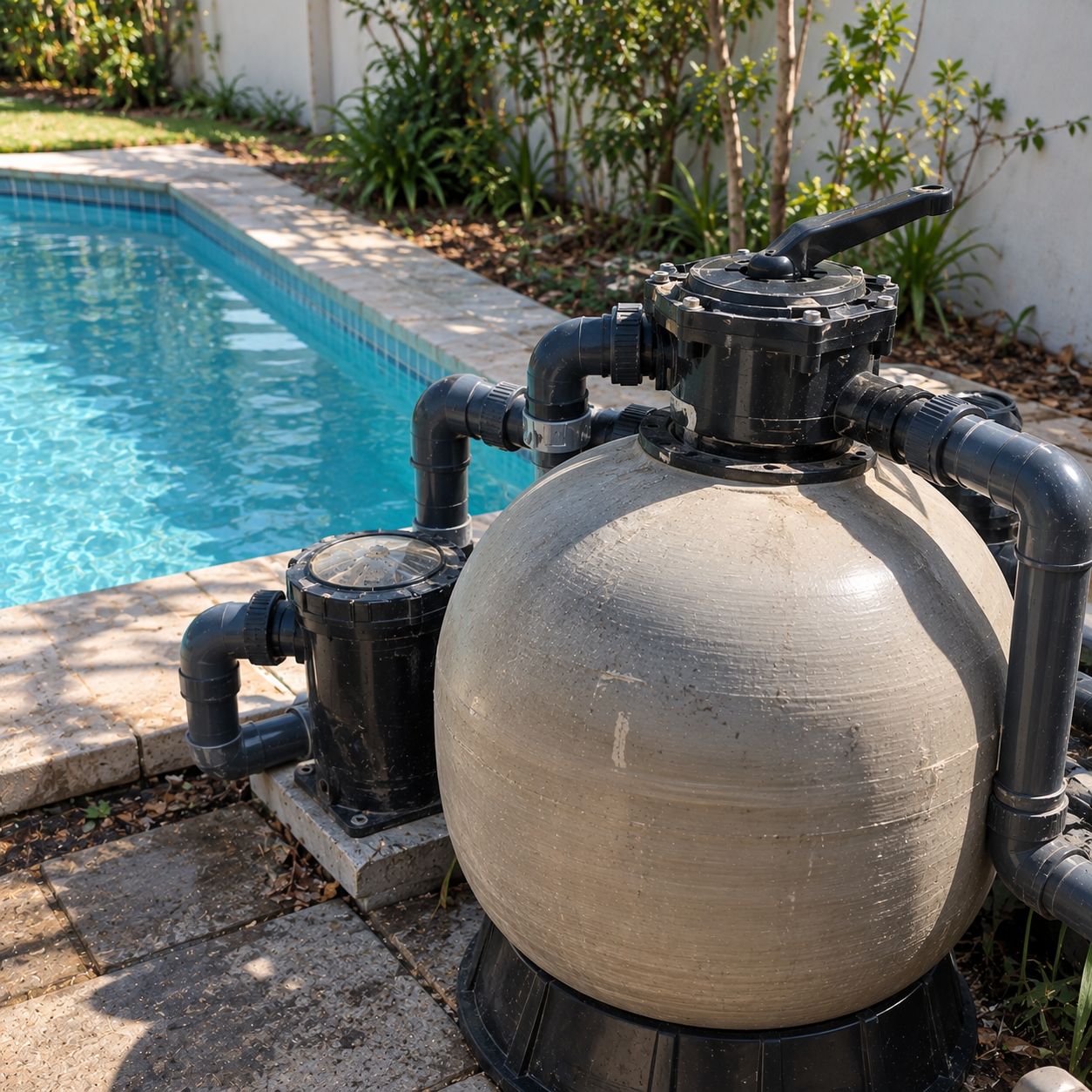
You backwash the filter, give the pool a good vacuum and check the chemicals, but the water still looks dull. A few days later, the same fine dirt is back on the floor, and the filter seems to need attention all over again. If this sounds familiar, it may be time to look beyond your usual cleaning routine.
The sand inside a pool filter can gradually lose its ability to trap fine particles. Sometimes it becomes clogged with contaminants that ordinary backwashing cannot remove effectively.Â
In other cases, water finds channels through the sand bed, allowing dirt to pass through the filter instead of being caught. The result can be a pool that never quite looks clean, even when the pump is running regularly.
That does not mean every cloudy pool needs new sand. Poor water chemistry, inadequate circulation, a damaged valve or a problem inside the filter can cause similar symptoms.Â
Replacing the sand without identifying the actual fault can leave you with the same problem and an unnecessary expense.
Get to the Bottom of Your Pool Filtration Problem
If your pool is staying cloudy despite regular maintenance, we can help assess its condition, check the filtration system and identify what may be affecting water clarity.
Cloudy Water That Refuses to Clear
Cloudy water is often the first thing that makes a pool owner suspect the filter. The water may look milky in the afternoon sun, appear hazy when viewed from the steps, or remain dull even after the pool has been cleaned.
A sand filter works by passing pool water through a bed of specially graded filter media. As the water moves through the spaces between the grains, suspended dirt and other particles become trapped. The cleaner water then returns to the pool through the return lines.
Over time, the condition of the sand bed can change. Contaminants may accumulate, the grains can wear down, or channels can develop through the media. When water passes through these channels, it can bypass areas that should be doing the filtering. Fine particles then remain in circulation, making the pool difficult to clear.
The timing matters. If the pool becomes cloudy after heavy use, a storm or a period of windy weather, the filter may simply be dealing with a larger amount of dirt than usual. If the water remains hazy for days despite appropriate filtration and balanced water chemistry, the filter needs closer attention.
Check the chlorine level and pH before assuming the sand is responsible. Algae, incorrect chemical balance and poor circulation can all affect clarity. A pool recovering from an algae treatment may also remain cloudy while dead algae and fine debris are removed.
If those issues have been addressed and the water still does not improve, worn, contaminated or channelled sand becomes a more likely explanation. The filter may need cleaning, an internal inspection or a complete media replacement, depending on what is causing the problem.
You Are Backwashing Much More Often
Backwashing reverses the flow of water through a sand filter to loosen trapped debris and send it out through the waste line. It is a normal maintenance task, but the frequency should make sense for your pool and its conditions.
Suppose you usually go several days between backwashing, but recently the pressure rises again shortly after cleaning. You backwash the filter, return it to normal operation and find yourself repeating the process sooner than expected. If the pool has not suddenly started collecting more dirt, something may have changed inside the filtration system.
Old or heavily contaminated sand can contribute to this pattern. Oils, organic material and mineral deposits may accumulate in the filter bed, and ordinary backwashing may not remove all of them. Compacted areas can also interfere with water flow.
However, the amount of debris entering the pool should not be overlooked. Cape Town’s windy conditions can carry dust, leaves and fine debris into outdoor pools. A pool that has recently turned green may also place an unusually heavy load on the filter as treatment removes algae and suspended material.
In those circumstances, more frequent backwashing may be reasonable for a while.
The better indication is whether the filter returns to its usual operating condition after cleaning. If it does not, or the same problem keeps returning despite a sensible maintenance routine, investigate further rather than backwashing repeatedly without identifying the cause.
Follow the filter manufacturer’s instructions and use the pressure gauge to monitor changes from the normal clean-filter reading. Backwashing unnecessarily can waste water, which is worth avoiding in a region where water conservation matters.
Dirt Keeps Coming Back After Vacuuming
You vacuum the pool floor until it looks clean, but the following day a fine layer of dirt has settled in the same area. Sometimes it gathers around the deep end or steps. On other occasions, tiny particles appear to drift through the water before settling.
The source of that material is important.
If fine debris is entering the pool faster than the filter can remove it, the floor may become dirty again even when the equipment is functioning correctly. Wind-blown dust, garden debris and material carried into the water by swimmers can all contribute. A dirty pool does not automatically mean the sand has failed.
The problem becomes more suspicious when the dirt is extremely fine and the pool never seems to reach a clear, settled condition. If the pump is running for an appropriate period, the water chemistry is balanced and the filter has been cleaned correctly, ineffective filtration may be allowing particles to circulate.
A channelled sand bed is one possible explanation. Water follows the easiest route through the filter rather than spreading evenly across the media. Some of the water receives inadequate filtration, so the same particles keep moving through the system.
There is another possibility worth checking before replacing anything: the material might actually be filter sand escaping into the pool.
If you repeatedly notice gritty deposits, particularly near the return outlets, the filter’s internal components may be damaged. The laterals at the bottom of the tank are designed to let filtered water pass through while retaining the sand. A cracked lateral, damaged standpipe or another internal fault can allow sand to enter the return line.
Replacing the sand alone will not repair a broken component. The filter needs to be inspected so the underlying fault can be corrected.
The Filter Pressure Does Not Behave Normally
Your filter’s pressure gauge is useful because it gives you a reference point for how the system normally operates. The important reading is not a universal number that applies to every pool, but the pressure your own filter shows when it is clean and running under its usual conditions.
As dirt accumulates in the sand bed, resistance to water flow generally increases. The pressure may rise, indicating that the filter needs backwashing or further investigation. Once the filter has been cleaned properly, the reading should usually move closer to its normal clean-filter pressure.
If the pressure rises quickly again, the filter may be dealing with a heavy debris load or a restriction that has not been resolved. Contaminated or compacted media can contribute to this problem.
A high reading can also result from a partially closed valve, a blocked return line or another restriction in the system. Before changing the sand, check whether the filter has been backwashed correctly and whether the plumbing and valves are allowing water to move freely.
Low pressure tells a different story. A blocked pump basket, low water level, air entering the suction line or a pump problem can reduce the amount of water moving through the filter. In that situation, the sand may be perfectly serviceable.
There is one complication: a filter can have a channelled sand bed even when the pressure looks reasonably normal. The gauge measures pressure, not how effectively the filter is capturing particles.
Look at the pressure alongside the pool’s water clarity, return flow and response to backwashing. A change in one reading is useful information, but the pattern across several symptoms is much more revealing.
Backwashing No Longer Restores Filtration
Backwashing should remove accumulated dirt and help the filter return to normal operation. If it no longer makes a noticeable difference, the filter may have a problem that routine cleaning cannot resolve.
The sand bed may be contaminated with oils, organic residue or mineral deposits that do not wash away easily. The grains may also have compacted into areas that restrict water movement, or channels may have formed that allow water to bypass much of the media.
You might notice that the pressure barely changes after backwashing, the water remains cloudy, or fine debris continues returning to the pool. These symptoms suggest that simply repeating the same cleaning process may not be enough.
First, make sure the backwashing procedure is correct. The pump should be switched off before changing the multiport valve setting. Follow the instructions for your filter, including the rinse cycle where required, before returning to normal filtration.
A faulty multiport valve can also cause problems. Its internal gasket may be worn or damaged, allowing water to pass through the wrong channels. If dirty water is bypassing the filter, replacing the sand will not necessarily resolve the issue.
When correct backwashing no longer restores performance, an inspection can establish whether the media is contaminated beyond effective cleaning, whether the internal components need attention, or whether another part of the circulation system is responsible.
The Sand Is Several Years Old
How long has it been since the sand was last changed? If you know the answer is six or seven years ago, for example, it is reasonable to consider its condition more closely, particularly if the pool has started showing other filtration problems.
Pool filter sand can last for several years, but there is no single replacement date that suits every filter. The expected lifespan depends on the media specified by the manufacturer, the pool’s usage, the amount of debris entering the water, water chemistry and the quality of ongoing maintenance.
A pool that has experienced repeated algae outbreaks or heavy contamination may place more demands on its filter than one that receives consistent care. The condition of the sand can therefore differ considerably between two pools of the same age.
Age alone is not proof that replacement is necessary. Sand may still look relatively normal when the filter is opened, even when its filtration performance has deteriorated. Equally, an older filter that maintains clear water, operates normally and responds well to backwashing may not need immediate replacement simply because several years have passed.
If you have recently moved into a property and do not know when the filter was last serviced, look for a combination of warning signs. Persistent cloudiness, recurring fine debris and poor recovery after backwashing are more meaningful when the media is also known to be old.
Check the filter manufacturer’s maintenance recommendations before deciding. If the media is approaching the end of its expected service life and performance is deteriorating, replacement may be a sensible long-term decision.
Hard, Clumped or Contaminated Sand
The condition of the media itself can help explain why a filter is no longer working properly, although a proper inspection usually requires the tank to be opened safely.
Sand should form a relatively even bed through which water can pass while particles are trapped. When oils, organic residues or mineral deposits accumulate, sections of the bed may become compacted or clump together. This interferes with the movement of water and can reduce effective filtration.
In some cases, the top of the sand bed may contain visible deposits or hardened areas. Other problems are less obvious and only become apparent when the media is removed.
Backwashing can remove loose dirt, but it cannot necessarily restore media that has become heavily contaminated or hardened by deposits. Depending on the condition of the sand and the filter manufacturer’s recommendations, replacing the media may be more effective than continuing to clean it.
Do not open a pressurised filter to check the sand yourself. The pump must be switched off, the system isolated as appropriate and all pressure released according to the manufacturer’s instructions. A filter tank can retain pressure even after the pump stops, so the correct procedure matters.
It is also important not to confuse a compacted sand bed with a mechanical fault. A damaged lateral, blocked internal passage or faulty valve can cause similar performance problems. The filter should be assessed as a complete system before new media is installed.
What Else Should You Check Before Buying New Sand?
Before spending money on replacement media, work through the simpler explanations for poor filtration. A few checks can help narrow down the cause.
Start with the water itself. Test the chlorine level and pH, and address any imbalance. If the pool has algae, determine whether treatment is needed rather than assuming the filter sand is responsible for the cloudy water.
Next, check the circulation system. The skimmer basket and pump basket should be clear, the pool water level should be suitable, and the pump should be moving water normally. Confirm that valves are in the correct positions and that the filter is being operated according to its instructions.
Then compare the filter’s pressure with its usual clean reading. If the pressure remains unusually high after a correct backwash, look for restrictions or a problem with the media. If pressure is low and the return flow is weak, investigate the pump and suction side before replacing the sand.
Finally, consider whether the filter has any signs of internal damage. Sand returning to the pool is a particularly useful clue because it may indicate a broken lateral or standpipe rather than worn media alone.
These checks do not require you to dismantle the filter. If the diagnosis involves opening the tank, replacing internal components or handling equipment you are unfamiliar with, it is safer to have the work assessed properly.
Let's Get Your Pool Filtration Back on Track
If backwashing is no longer helping or you suspect a fault inside your filter, we can help assess the pump, filtration system and overall pool condition before you commit to replacing the sand.
What Does Pool Filter Sand Replacement Involve?
Replacing the sand is a physical job, and the condition of the filter’s internal components should be checked while the tank is open. The work is not simply a matter of removing the old material and pouring in a new bag.
The system must first be switched off and depressurised according to the manufacturer’s instructions. The filter is then opened, and the old media is removed so the internal assembly can be inspected.
The laterals, central standpipe and other relevant components need to be checked for cracks, damage or signs of wear. Seals and valve connections may also need attention, depending on the filter’s condition. This inspection matters because a damaged component can undermine the performance of newly installed sand.
The replacement media must match the filter manufacturer’s specifications. Ordinary building sand or play sand is not a suitable substitute simply because it looks similar. The correct media type, grain size and quantity depend on the particular filter.
Once the old sand has been removed and the internals checked, the new media can be installed carefully. The tank is reassembled, and the filter is started using the manufacturer’s recommended sequence, including backwashing and rinsing where required.
Afterwards, the system should be checked for leaks, unusual pressure readings and any sand returning to the pool. The clean operating pressure should also be recorded as a baseline for future maintenance.
The condition of the filter may reveal that more than the sand needs attention. If the laterals or valve are damaged, those issues should be addressed during the work rather than left to cause the same problem again.
What Affects the Cost of Replacing Pool Filter Sand?
The cost depends on the filter and the work required, so it is not sensible to quote a single price without knowing the equipment involved.
The amount of media needed is one factor. Larger filters generally require more replacement material, and the correct quantity must be taken from the manufacturer’s specifications. The type of media specified for the filter also affects material costs.
Labour is another consideration. Removing wet or compacted sand can be time-consuming, particularly where access around the tank is restricted. The filter’s design can affect how easily the valve and internal assembly can be reached.
The condition of the internal components can make a difference too. If the laterals, standpipe, valve seals or other parts are damaged, repairs may be necessary in addition to replacing the media. It is worth identifying those faults while the tank is already open, rather than paying for the same dismantling work again later.
The most economical solution is not always the one with the lowest initial price. Replacing sand that is still working properly is an avoidable expense, but leaving genuinely worn media in place can mean continued poor filtration, repeated cleaning and unnecessary chemical use.
A proper assessment helps establish whether the sand needs replacing, whether a repair will solve the problem, and what work is actually required.
Keeping Your Filter Sand in Better Condition
You cannot keep filter sand in service indefinitely, but consistent pool maintenance helps the filtration system work as intended and makes problems easier to spot.
Remove leaves and larger debris before they accumulate, vacuum the floor as needed, and keep the skimmer and pump baskets clear. These steps reduce the amount of material the filter has to handle.
Water chemistry matters as well. Test the water regularly and correct imbalances before they contribute to recurring algae or other water-quality problems. If algae develops, address both the water treatment and the filtration demands created by the treatment process.
Backwash when the filter requires it, following the manufacturer’s instructions and using the pressure gauge as a guide. Avoid both extremes: leaving the filter clogged with debris and backwashing unnecessarily often.
Pay attention to changes in performance. If the water takes longer to clear, pressure rises unusually quickly or the filter no longer responds to cleaning, investigate the cause before the problem becomes more difficult to manage.
Regular pool maintenance includes more than cleaning the visible surfaces. Checking water chemistry, circulation and filtration helps identify problems that may otherwise go unnoticed until the pool becomes persistently cloudy or equipment starts malfunctioning. Cape Pools covers these checks as part of its pool cleaning and maintenance services.Â
Conclusion
Pool filter sand usually gives you clues when it is no longer doing its job properly. Water that stays cloudy, fine dirt that keeps returning, repeated backwashing and a filter that does not recover after cleaning are all reasons to investigate. When several of these problems occur together, especially in an older filter, the sand may need replacing.
Still, the symptoms need to be interpreted carefully. Cloudy water can be caused by poor chemical balance or inadequate circulation, while sand appearing in the pool may point to damaged internal components. Replacing the media without checking these possibilities can leave the original problem unresolved.
The sensible next step is to assess the filter as a whole. If the sand is contaminated, channelled or no longer effective, replacement can restore proper filtration. If the problem lies elsewhere, repairing the actual fault is the better use of your money.
A clean pool depends on the pump, filter, water chemistry and regular maintenance working together. Keeping an eye on how your system performs will help you recognise when routine cleaning is enough and when the filter needs more attention.
Need Help With Your Pool Filter?
Tell us what you have noticed, whether it is cloudy water, frequent backwashing or sand returning to the pool. We can help you work out what needs attention and discuss the appropriate maintenance options.

Comments are closed