



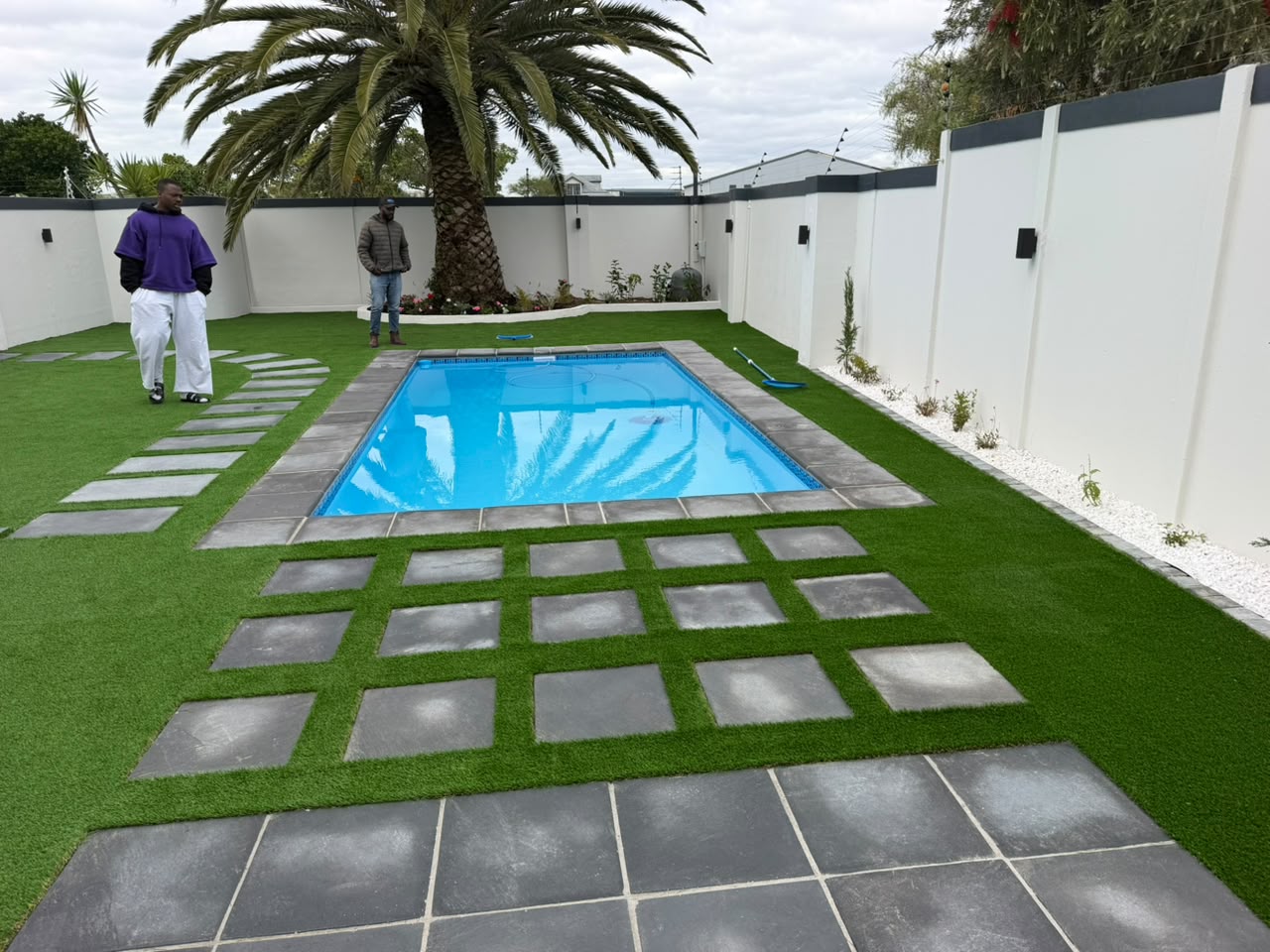
A swimming pool is a major investment, and for many Cape Town homeowners, the quotation is one of the biggest factors in deciding which contractor to use. After comparing a few prices, it can be tempting to choose the company offering the lowest amount, especially when the difference between quotes runs into thousands of rands.
The problem is that the cheapest quotation does not always represent the cheapest completed swimming pool.
One contractor might include excavation, rubble removal, plumbing, filtration equipment and basic paving, while another might quote only for the pool shell and installation labour. Both quotations may look as though they cover the same project, but the final costs can be very different.
There is also the question of workmanship. A pool that looks perfectly fine when it is first filled can develop problems later if the ground preparation, plumbing, backfilling or finishing work has not been handled correctly. Repairs can disrupt the garden, add unexpected expenses and leave the homeowner paying for work that should have been completed properly the first time.
For homeowners planning a swimming pool installation in Cape Town, the goal should not be to spend the most money. It should be to understand exactly what is being offered, what the price includes and whether the proposed work is suitable for the property.
A lower quote can be a genuine saving. However, when the price is low because important work has been excluded or corners are being cut, the initial saving can disappear quickly.
Planning a Swimming Pool Installation?
Get a clearer picture of what your property needs before committing to a contractor. Cape Pools can help you assess your swimming pool project and discuss suitable installation options.
1. The Quotation May Not Include Everything You Need
One of the most common reasons swimming pool quotations differ is that contractors do not always include the same work in their prices.
A homeowner might receive three quotations for a fibreglass pool and assume the lowest price offers the best deal. However, a closer look at the documents may reveal that one contractor has included several essential parts of the project while another has listed them as additional costs.
For example, the initial quotation might cover the fibreglass shell, delivery and installation, but exclude the removal of excavated soil, additional plumbing, electrical work, paving or the finishing around the pool. Those items still need to be dealt with before the project is complete.
This is where a seemingly affordable installation can become considerably more expensive.
Imagine receiving a quote that is R20,000 cheaper than another contractor’s offer. At first, the saving looks attractive. But if the cheaper quote excludes work that costs R25,000 to complete, the apparent saving has disappeared, and the project has become more expensive than the alternative.
The figures in this example are illustrative, not an estimate of typical installation costs. The actual difference depends on the pool, property, specifications and work required.
The important point is that the total project cost matters more than the price printed at the bottom of the first quotation.
Before accepting an offer, ask for a written breakdown of what is included. Check whether the quotation covers the pool structure or shell, delivery, excavation, soil removal, base preparation, installation labour, plumbing, pump and filtration equipment, backfilling, coping, paving and final checks.
Not every project requires the same work, and some homeowners deliberately choose to handle certain finishing tasks separately. That is perfectly reasonable, provided the exclusions are understood and budgeted for from the beginning.
Before accepting a quotation, check exactly what the installation includes, from excavation and equipment to backfilling and finishing.
Knowing what is included in a new pool installation package can help you compare quotes fairly and identify additional costs before they catch you off guard.
2. Excavation and Site Conditions Can Change the Final Cost
The ground beneath your garden can have a significant effect on a swimming pool installation. Unfortunately, these details are easy to overlook when comparing quotations, particularly if the contractors have not assessed the property properly.
Cape Town properties vary considerably. One homeowner might have a relatively level garden with easy access for machinery, while another might have a sloping backyard, limited access between buildings or ground that is difficult to excavate.
These differences can affect the equipment, labour and preparation required to install the pool safely.
Rocky ground, for example, can make excavation more complicated than digging through ordinary soil. Depending on the conditions, additional machinery, labour or time may be needed. Clay soil and groundwater can also influence drainage and the preparation required around the pool.
The amount of soil that needs to be removed is another consideration. Excavated material takes up space, and removing it from the property may involve additional transport and disposal costs. A quotation that does not clearly explain how excavation and soil removal are handled may leave the homeowner facing an unexpected bill.
Access is equally important. If machinery cannot reach the proposed pool site directly, the contractor may need an alternative method of moving soil or materials. A narrow side passage, boundary wall or limited working space can affect how the work is carried out.
A very low quotation is not automatically a warning sign if the contractor has assessed the site and can explain how the price has been calculated. The concern arises when a contractor offers a firm price without properly considering conditions that could materially affect the work.
For a new fibreglass pool, the assessment should also consider where the shell will be delivered and how it will be positioned. Some properties allow straightforward access, while others may require a crane to lift the shell over a building or boundary wall.
Crane-assisted installation introduces its own logistical requirements. The contractor needs to consider the lifting position, available space, access for the crane and any relevant restrictions at the property. If the quotation excludes this work, the homeowner needs to know before the project begins.
This is why an on-site assessment can be so valuable. It gives the contractor an opportunity to identify potential complications and explain which costs are included, which depend on the conditions encountered and which would require a separate agreement.
3. Poor Ground Preparation Can Lead to Expensive Pool Problems
A swimming pool is only as dependable as the work supporting it. The pool shell may be manufactured to a high standard, but that alone cannot compensate for poor preparation beneath or around it.
This is particularly relevant to fibreglass pools, which need an appropriately prepared and level base, correct positioning and suitable backfilling. These stages are essential parts of the installation rather than minor details that can be rushed to finish the job sooner.
If the base is uneven or inadequately prepared, the shell may not be supported as intended. Problems can also arise if backfilling is performed incorrectly or the installation process does not account for the ground and drainage conditions.
The exact risks depend on the pool design, site and installation method, but poor workmanship can contribute to movement, deformation, damage or problems around the pool’s fittings and surrounding finishes.
Correct backfilling is particularly important. The material and method must be suitable for the pool system, and the installation process needs to maintain the appropriate support around the shell. Simply placing a pool into an excavated hole and filling the surrounding space is not an adequate substitute for following the required installation procedure.
Drainage also deserves attention. Water accumulating around or beneath a pool can create additional pressure, particularly where groundwater is present. Site-specific drainage measures may be necessary, depending on the conditions.
The difficulty for homeowners is that these problems may not be immediately obvious. The pool could look level and attractive when the work is completed, only for signs of movement or damage to become apparent later.
Repairing such issues can be far more disruptive than addressing the underlying requirements during installation. Depending on the nature of the damage, work might involve investigating the cause, removing surrounding finishes, repairing affected areas or undertaking more extensive remedial work.
A contractor who allows adequate time for preparation and follows the appropriate installation method may charge more initially than one who rushes through the work. That difference should not automatically be viewed as an unnecessary expense.
When comparing quotations, ask how the base will be prepared, how the shell will be supported and what backfilling method will be used. The answers should be clear enough for you to understand what the installation involves.
A fibreglass pool needs a properly prepared base, careful positioning and correct backfilling to ensure the shell is adequately supported.Â
Rushing these stages can lead to problems that are far more expensive to correct once the surrounding paving and finishing work is complete.Â
That is why understanding the fibreglass pool installation process in Cape Town is useful when comparing quotations, as the price should account for the work needed to install the pool correctly, not just the pool shell itself.
4. Cheap Materials and Inadequate Equipment Can Affect Long-Term Costs
The pool itself is only one part of the finished installation. Pumps, filters, pipework, fittings and other components all contribute to how the system operates.
A low quotation may specify equipment that is different from what another contractor has included. Even when both quotations mention a pump and filter, that does not necessarily mean the equipment is identical in specification or suitability.
The equipment needs to be appropriate for the pool and its circulation requirements. An unsuitable setup can affect filtration performance, operating efficiency and the amount of attention needed to keep the water in good condition.
Pipework and fittings also matter. Poor installation, unsuitable components or inadequate checks can contribute to leaks and other faults. If a problem develops after the contractor has left, the homeowner may need to pay for investigation, replacement parts and labour.
The same principle applies to the surrounding finishes. Paving, coping and other materials should be suitable for their intended use and installed correctly. A lower price might reflect a perfectly acceptable, simpler finish, but it could also reflect a difference in material quality or the amount of preparation included.
There is nothing wrong with choosing a basic pool package. Not every homeowner needs premium finishes, elaborate lighting or heating equipment. A straightforward design can be a sensible way to control the budget.
The important distinction is between choosing simpler specifications deliberately and accepting lower-quality work without understanding the consequences.
Ask each contractor to identify the equipment and materials included in the quote. Where relevant, request product names, model numbers, specifications and information about applicable warranties. If one quotation is significantly cheaper, ask the contractor to explain the difference rather than assuming that the products are equivalent.
It is also worth considering future maintenance. A small saving on the initial installation may not be worthwhile if it results in more frequent repairs or unnecessary operating costs. Equally, a more expensive product is not automatically the better option. Suitability, installation quality, availability of replacement parts and ongoing requirements all deserve consideration.
5. Rushed Work Can Cost More to Put Right
Price and workmanship are closely connected, but a low price alone does not prove that a contractor will do a poor job. Some companies may have lower overheads, different package structures or more efficient ways of working.
The concern is whether the quoted price allows the contractor to complete the agreed work properly.
A swimming pool installation involves several stages that need to be coordinated. Excavation must be completed to the required dimensions, the base needs to be prepared, the pool must be positioned correctly, and the plumbing, backfilling and finishing work must be carried out in the appropriate sequence.
If these stages are rushed or handled carelessly, the homeowner may face problems that are expensive to investigate and repair.
Consider the difference between two contractors. One provides a detailed quotation, explains the installation process and allows time for the work to be completed correctly. The other offers a much lower price but cannot clearly explain how the installation will be carried out or what checks will take place before handover.
The first contractor may appear more expensive at the outset. However, a clear process gives the homeowner a better understanding of what to expect and provides a basis for checking whether the agreed work has been completed.
Before making a decision, ask who will carry out the installation, who will supervise the work and how problems will be handled if something does not go according to plan.
You should also establish what the contractor will check before handing over the pool. Depending on the project, this may include checking the plumbing for leaks, testing the pump and filtration system, inspecting the finished installation and explaining how the equipment should be operated.
A professional handover matters because the homeowner needs to know how to use and care for the pool once the installation team has finished.
Do not rely solely on verbal assurances. Important details about the scope of work, payment arrangements, expected completion stages and applicable warranties should be recorded in writing.
Comparing Pool Quotes and Need a Second Opinion?
Cape Pools can help you understand the work involved in your swimming pool project, from installation requirements to the equipment and finishing options that suit your property.
6. Repairs and Warranty Disputes Can Wipe Out the Initial Saving
One of the most frustrating outcomes of choosing a pool contractor is discovering a problem after the installation has been completed, only to find that resolving it is more complicated than expected.
A leak, damaged finish, plumbing fault or equipment failure can be inconvenient on its own. The situation becomes more difficult if there is disagreement about whether the problem is covered by a warranty, whether the original installation caused it or who is responsible for the repair.
Warranty terms therefore deserve attention before you accept a quotation.
Ask what warranty applies to the pool shell, installation workmanship, equipment and any other supplied components. These may have different terms, conditions and exclusions. A manufacturer’s product warranty should not automatically be assumed to cover every aspect of the installation.
You should also establish how to report a fault, who will assess it and what happens if a repair is needed. Make sure any warranty conditions are supplied in writing and that you understand what could affect the cover.
A cheap quotation that offers vague assurances about warranties may leave important questions unanswered. A higher-priced quotation is not necessarily better simply because it mentions a warranty, either. The actual terms and the contractor’s documented responsibilities are what matter.
It is also useful to understand what the quotation says about changes and additional work. If unexpected ground conditions are encountered, for example, the contractor should explain the issue and agree on the additional work and cost before proceeding, wherever practicable.
This protects both parties. The contractor has a way to deal with genuinely unforeseen conditions, while the homeowner has a clearer understanding of why the original price needs to change.
If you are comparing quotations, pay attention to the wording around defects, repairs, exclusions and additional charges. Unclear terms can create problems long after the original price has been forgotten.
For existing pools, the same principle applies to repairs and renovations. A quick, inexpensive fix might be appropriate for a minor problem, but recurring leaks or deteriorating surfaces may need a more thorough assessment. Paying repeatedly for temporary repairs can eventually cost more than choosing a suitable long-term solution.
Cape Pools provides fibreglass pool relining and repair services for existing pools where the condition and structure make that approach appropriate. The right solution depends on the pool’s actual condition, so the scope of work should be based on an assessment rather than price alone.
7. Finishing Work Can Turn an Affordable Pool Into an Expensive Project
A swimming pool is rarely judged by the shell alone. Homeowners also need to consider how it connects to the garden, patio, house and surrounding outdoor space.
The area around the pool may need coping, paving, drainage, landscaping or other finishing work. Depending on the design, there may also be fencing or an appropriate safety cover, lighting, heating and additional features to consider.
These items can make a substantial difference to the completed project, but they are not necessarily included in every installation quote.
This can create a misleading comparison. One contractor may offer a basic installation with minimal finishing, while another includes a more complete pool area. The second quotation will naturally be higher, even if both contractors are charging reasonable prices for the work they have specified.
Problems arise when homeowners compare the totals without checking the details and later discover that the cheaper option does not include the finish they expected.
Before accepting a quote, decide what you want the completed pool area to look like. You may not need every feature immediately, and some upgrades can be completed later if they are planned properly. However, essential work should be identified and budgeted for from the start.
For example, a homeowner might initially plan for a simple pool with basic paving, only to discover that additional work is required to connect the pool area neatly to an existing patio. Another homeowner might expect the contractor to remove all excavation material, while the quotation only covers digging.
These are not necessarily examples of dishonest pricing. They can result from different assumptions about what the project includes. A detailed written scope helps prevent those assumptions from becoming expensive disagreements.
It is also worth considering practical use. The cheapest finishing option may not be the most suitable for the way the area will be used, while the most expensive option may offer features that are not necessary for your household.
The best choice is one that meets your needs, suits your property and fits within a realistic overall budget.
8. Cape Town Properties Can Have Installation Challenges That Need to Be Priced Properly
Cape Town is not made up of identical properties, and a pool installation that is straightforward in one garden may require a different approach in another.
Some properties have generous access and level ground. Others have steep sections, narrow passages, established structures or limited room for machinery. Coastal conditions, drainage requirements and the layout of the garden can also influence planning.
These factors do not automatically make a pool installation expensive. They simply mean that the quotation needs to reflect the actual site rather than an assumed standard installation.
A property with difficult access may require additional planning for excavation, delivery or the movement of materials. A sloping site might need more attention to levels and the surrounding ground. Where a crane is required to position a fibreglass shell, the contractor needs to account for the lifting arrangements and site logistics.
Planning requirements should also be clarified. Homeowners should establish what approvals and safety measures apply to their particular pool project, who is responsible for arranging any required submissions and whether related fees are included in the quotation.
It is risky to assume that every pool installation follows the same process or has the same approval requirements. The details should be confirmed for the property and the proposed work.
This is another reason to be cautious about quotations that are provided without enough information about the site. A low figure based on incomplete assumptions may need to be revised once the contractor discovers what the property actually requires.
A realistic quotation should make it easier to understand the planned work and identify costs that may depend on conditions that cannot be confirmed in advance.
The aim is not to eliminate every possibility of an additional expense. Some conditions only become apparent once work begins. The aim is to identify foreseeable issues early, explain the uncertainties and agree on how additional work will be priced and approved.
9. How to Compare Pool Quotations Without Paying More Than Necessary
You do not need to choose the most expensive contractor to get a good swimming pool. Nor should you dismiss a competitive quotation simply because it is cheaper than the others.
What matters is whether the contractor has understood your requirements, priced the work realistically and explained what you will receive for the amount quoted.
Start by comparing quotations line by line. If one includes excavation and rubble removal while another excludes them, ask for the missing items to be priced so you can make a fair comparison. Do the same for plumbing, filtration equipment, backfilling, paving and any other work that forms part of your planned installation.
Next, ask questions about anything that is unclear. A contractor should be able to explain the scope of work, the materials and equipment being supplied, the expected stages of the project and how additional costs will be handled.
Consider the contractor’s experience with the type of pool you want. A fibreglass installation has different requirements from a concrete pool, and a site with difficult access may need particular planning. Ask for relevant examples of completed work where available, and check references if they can be provided.
Review the payment terms as well. Understand when deposits and progress payments are due, which stages trigger payment and what documentation you will receive. Avoid relying on a vague verbal agreement for a project involving a substantial amount of money.
Finally, look at the total cost of achieving the result you want, rather than focusing only on the initial installation figure.
The following checklist can help you compare offers consistently:
-
Scope of work: What exactly will the contractor install, and which tasks are excluded?
-
Site preparation: Are excavation, soil removal, base preparation and any known access requirements covered?
-
Equipment and materials: Are the pump, filter, plumbing and finishes clearly specified?
-
Approvals and safety: Who is responsible for confirming and arranging the requirements that apply to the property?
-
Workmanship and warranty: What written warranties apply, and how will defects be handled?
-
Additional costs: How will unexpected conditions, variations and extra work be priced and approved?
-
Completion and handover: What checks, demonstrations and documents will be provided when the work is finished?
Once these details are clear, the cheapest quotation may still be the best option. The difference is that you will be making the decision based on the actual offer rather than an attractive headline price.
10. When Paying More Is Worth It, and When It Isn’t
There is a difference between paying a fair price for a properly planned installation and paying extra for features or services you do not need.
A contractor who offers a higher quotation should be able to explain what justifies the price. Perhaps the offer includes more complete excavation and removal, specified equipment, better-defined finishing work or additional site preparation. You can then decide whether those inclusions are relevant to your project.
If the more expensive quotation simply includes upgrades you never requested, ask for an alternative that matches your preferred specifications. You should not have to purchase unnecessary extras to obtain a suitable pool.
Likewise, a cheaper contractor may offer excellent value if the scope is complete, the materials are appropriate and the installation will be carried out correctly. Lower overheads, efficient scheduling or a simpler package can all contribute to a competitive price.
The warning signs are not the low price itself. They are unexplained differences, missing information, unrealistic promises or reluctance to put important commitments in writing.
If a contractor cannot explain why the quote is substantially lower than comparable offers, it is reasonable to ask more questions before committing. A clear explanation may resolve your concerns. If the answers remain vague, taking more time to compare your options could save you considerable trouble later.
The same approach applies when working within a strict budget. Rather than choosing the cheapest offer without reviewing it, discuss which features can be simplified or postponed without compromising essential installation work.
You might choose a more modest pool size, a simpler finish or fewer optional features. These are deliberate budget decisions. Cutting out necessary preparation, using unsuitable equipment or leaving important work undefined is a different matter.
A successful pool project is not the one that costs the most. It is the one that delivers the pool you agreed to, within a clearly understood budget, with the work completed to an appropriate standard.
Conclusion: Look Beyond the Price of the Pool
Choosing a swimming pool contractor is a decision that deserves more than a quick comparison of totals. The cheapest quote could represent a genuine opportunity to save money, but it could also leave out essential work, underestimate site requirements or fail to explain how the installation will be completed.
For Cape Town homeowners, the condition of the property, access, excavation, drainage, equipment and finishing requirements can all influence the final cost. Understanding these factors before work begins makes it easier to compare quotations fairly and avoid unpleasant surprises.
Take the time to review what each contractor includes, ask questions about anything unclear and get important commitments in writing. If the prices differ considerably, find out why before making your decision.
Most importantly, do not assume that a higher price guarantees better workmanship or that a lower price automatically means poor quality. The value lies in the complete offer, the suitability of the proposed work and the confidence you have in the contractor’s ability to deliver it.
A swimming pool should be something you can enjoy, not a project that continues to generate unexpected expenses because important details were overlooked at the beginning.
Planning a Swimming Pool in Cape Town?
Before you commit to a quotation, speak to Cape Pools about your property, installation requirements and the options available for your project. A clear understanding of the work is the first step towards making a confident decision.

Comments are closed